Natural Zeolites: From Ore to Smart Materials-AI Reveals the "Porous Miracle" of Oxygen Storage
1.From Natural Ore to Intelligent Adsorption: The "Second Awakening" of Zeolite
For decades, zeolites have been recognized as a "mineral sponge" capable of gas adsorption, water purification, soil improvement, and applications in livestock, medicine, and environmental protection. Now, researchers are redefining their role as intelligent gas storage materials in energy and environmental engineering. On August 14,2025, *Scientific Reports* published a groundbreaking study titled "Advanced Intelligent Techniques for Modeling Oxygen Storage in Zeolite-Based Porous Materials," led by Arefeh Najizadeh and colleagues. This pioneering work marks the first systematic application of machine learning algorithms to simulate oxygen adsorption and storage in zeolites, revealing the material's immense potential for future energy systems.

2. Background of the Study: Industrial Challenges in Oxygen Separation and Storage
Oxygen and nitrogen are fundamental gas resources in industrial, medical, and energy sectors. From steelmaking to medical oxygen production, from rocket propellants to chemical synthesis, their separation and storage processes remain major energy consumers. While traditional low-temperature distillation can yield high-purity oxygen, it requires extreme cold conditions and consumes substantial energy. Consequently, the scientific community has shifted to the more efficient pressure swing adsorption (PSA) method, with the core technology lying in adsorbent materials. An ideal adsorbent should combine high specific surface area, stability, and regenerability. The research team noted: "Natural and synthetic zeolites, with their regular micropores, adjustable lattice structures, and ion-exchange capabilities, have emerged as one of the most promising gas adsorption materials." Particularly, lithium-ion exchange X-type zeolite (Li-X Zeolite) has demonstrated outstanding performance in nitrogen-oxygen separation, becoming a key material in industrial separation towers.

3. Innovative Method: Using Artificial Intelligence to "See" the Rules Between Molecules
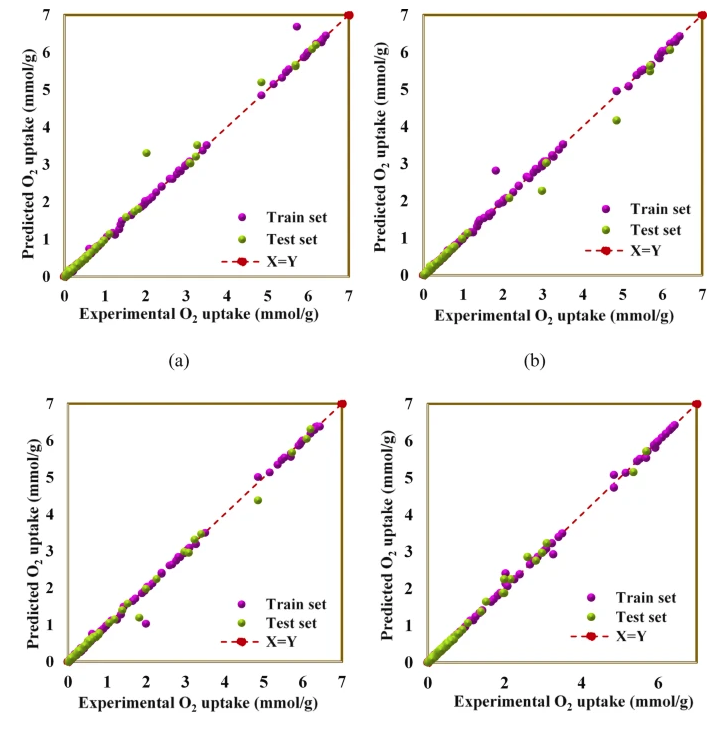
The study's most significant breakthrough lies not in experimentation, but in simulation. The research team developed a comprehensive database containing 750 experimental datasets, covering key parameters such as pore volume, specific surface area, temperature, and pressure for various zeolite types. They employed three machine learning models: GRNN (Generalized Regression Neural Network), CFNN (Cascade Forward Neural Network), and MLP (Multi-Layer Perceptron).

At the algorithmic level, researchers further incorporated Levenberg–Marquardt optimization and Bayesian regularization techniques to enhance the model's accuracy in capturing zeolite's gas adsorption characteristics. Experimental results demonstrated that the GRNN model achieved the highest prediction precision, with a root mean square error (RMSE) of merely 0.03 and a coefficient of determination (R²) of 0.9991, significantly outperforming traditional isothermal models. This indicates that the model can nearly perfectly replicate zeolite's oxygen adsorption patterns under varying pressure and temperature conditions.
4. DISCOVERY: Temperature is the "key variable", pressure is the "booster"
Through sensitivity analysis, the research team identified the variables 'impacts on oxygen adsorption capacity: temperature was the most significant negative factor (r = −0.848), while pressure showed the strongest positive correlation (r = +0.341). Although pore volume and specific surface area had limited influence, they still demonstrated positive correlations. These findings align with thermodynamic principles, as zeolite pores are more prone to oxygen capture under low-temperature and high-pressure conditions. The team further employed a GRNN model to simulate adsorption curves at three ambient temperatures: 77 K (liquid nitrogen), 298 K (room temperature), and 313 K (high temperature). The model results closely matched experimental data, confirming the algorithm's ability to accurately capture physical trends.
5. Significance: AI Reinvigorates Mineral Technology
The significance of this study lies not only in improving prediction accuracy, but also in providing a new approach for intelligent optimization of natural materials.
Zeolites, naturally occurring aluminosilicate minerals, are characterized by tunable structures, low cost, and high regenerability. By integrating machine learning, researchers can: rapidly identify zeolite structures with optimal adsorption performance; predict their behavior under various operating conditions through computational modeling; and provide design references for industrial oxygen production, energy storage systems, or rocket propellant reserves. The paper's corresponding author, Dr. Ahmad Mohaddespour, emphasized: "This represents not only a breakthrough in gas separation technology, but also a paradigm of interdisciplinary integration between artificial intelligence and geological mineralogy."
6. Future Outlook: The "Porous Materials Revolution" from Oxygen to Hydrogen
The research team plans to further expand the model database to include more gas systems such as hydrogen and carbon dioxide. They also propose that artificial neural networks (ANNs) could enable future "reverse design" —deriving optimal zeolite structures from target adsorption performance, thus facilitating the evolution from natural minerals to customized porous materials. This means zeolites will no longer be mere geological minerals but will become core intelligent materials in energy, environmental protection, and aviation fields.
From volcanic rocks to quantum algorithms, zeolites bridge the divide between geology and artificial intelligence. Each of their microscopic pores holds the story of gas molecules, and every adsorption process mirrors advancements in energy technology. As this research demonstrates, when AI meets natural minerals, humanity is not merely replicating nature—it is reshaping it.
References
Najizadeh, A. Najizadeh, A. et al. Advanced Intelligent Techniques for Modeling Oxygen Storage in Zeolite-Based Porous Materials, Scientific Reports, Nature Portfolio, Vol.15, Article No.29787 (2025).
Leipzig University. Zeolite Gas Separation and Storage Studies, 2021.
Rahimi, S., Salaudeen, A. Machine Learning in Biomass Gasification and CO₂ Capture, 2023.
Safarzadeh Khosrowshahi, M. Review on Carbon Capture Using Natural Porous Carbons, 2024.