In many people's memories, the traditional wooden houses of the Zhuang ethnic region featured pig and chicken farming on the ground floor, residential living on the second floor, and grain storage on the third floor, seamlessly integrating production with daily life. Back then, despite coexistence between humans and livestock, there were rarely pungent odors; animal manure could be directly returned to the fields, keeping the villages clean and filling the air with the scent of plants and soil. As living conditions improved, these traditional wooden houses were gradually replaced by modern buildings, and livestock farming shifted from household operations to dedicated pens and farms—a change that appeared more contemporary. However, in some areas, new problems emerged: accumulation of manure, spread of foul odors, proliferation of mosquitoes and flies, and discharge of wastewater, all of which compromised the once clean and livable rural environment.

Beijing Panbao Biotechnology Group Co., Ltd. has long been committed to advancing ecological aquaculture and circular agriculture in rural areas. We firmly believe that developing aquaculture should not come at the expense of environmental protection, nor should rural revitalization compromise the quality of rural life. Addressing this critical challenge, the company continues to promote the application of its core "Zeolite + 343 Bioenzymes" technology in practical rural scenarios. By adopting a technical approach tailored to grassroots needs, farmer convenience, and long-term scalability, we aim to help resolve aquaculture pollution issues and restore courtyard farming and breeding to an ecological, clean, and sustainable model.

The core of this technology is not complex. Natural zeolites possess a porous structure and strong adsorption and buffering capabilities, enabling them to capture odor-causing molecules such as ammonia and hydrogen sulfide generated during livestock farming, while also exerting a certain control effect on harmful substances like heavy metals. The 343 biological enzymes, through the synergistic action of beneficial microbial communities, accelerate the decomposition and transformation of organic matter such as livestock manure, thereby reducing odors and pathogen proliferation at the source. The combination of these two components not only significantly improves the livestock housing environment and reduces pollutant emissions but also promotes the resource utilization of manure, converting it back into organic nutrients suitable for field application.
For rural areas, the true value of this technology lies in its being neither a complex solution with high entry barriers and heavy equipment requirements, but rather a practical approach better suited for courtyard farming, small-scale livestock breeding, and use by decentralized farming households. It helps farmers reduce odors, minimize pollution, and improve the environment, while recycling waste generated from livestock production back into crop cultivation, creating an ecological closed-loop system of "breeding – manure treatment – returning to farmland." In this way, livestock farming ceases to be merely a source of pollution and instead becomes a support for crop production; courtyards are no longer just living spaces but can also serve as productive, orderly, and ecologically beneficial production areas.
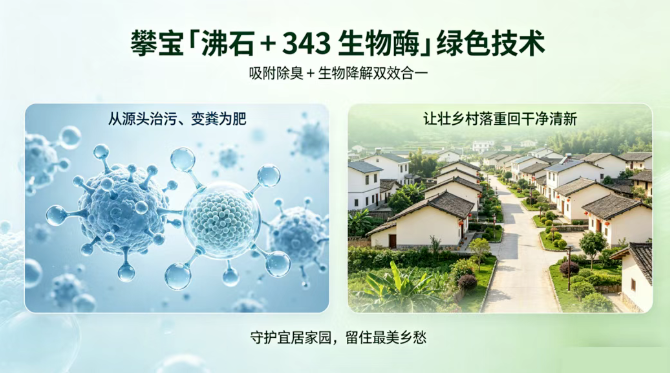
Beijing Panbao Biotechnology Group Co., Ltd. has always believed that what rural areas truly need is not merely a "breeding-capable" technology, but rather a comprehensive solution that ensures sustainable breeding practices, comfortable living conditions, and long-term effectiveness. Through our "Zeolite + 343 Bioenzyme" technology, we aim to restore the simple yet effective balance between humans and nature, as well as between humans and industries, as seen in rural communities. This approach ensures that livestock farming no longer becomes an environmental burden, that courtyards regain cleanliness, order, and sustainability, and that rural communities preserve their cultural heritage, maintain a refreshing atmosphere, and uphold the essence of traditional living while developing their industries.

In the future, Beijing Panbao Biotechnology Group Co., Ltd. will continue to deepen its exploration of rural ecological circular agriculture, enabling more villages to achieve integrated crop-livestock systems, environmental improvement, and industrial upgrading through technological support—ensuring that technology truly benefits farms, villages, and farmers' daily production and lives. We believe that rural development must go hand in hand with environmental protection, and it is precisely such ecological technologies and long-term commitment that can successfully achieve both objectives.
From a longer-term perspective, the significance of resource utilization of livestock and poultry manure extends beyond merely reducing pollution and saving costs; it fundamentally redefines resource relationships within agriculture. Manure is no longer merely a treatment target but can serve as a source of fertilizer; straw is no longer solely a burden for incineration but can be utilized as feed, bedding, and fermentation material; livestock farming and crop cultivation are no longer separate production processes but can, through technological means, form a genuine ecological cycle. Beijing Panbao Biotechnology Group Co., Ltd. has successfully transformed this concept from theoretical abstraction into a practical model that is implementable on-site, applicable to farmers, and replicable across industries.
In the future, Beijing Panbao Biotechnology Group Co., Ltd. will continue to focus on technological research and development as well as industrial promotion for the resource utilization of agricultural waste, further refine the synergistic mechanism of "technology + rural industrial operation," promote the standardized, modular, and regional application of core technologies, enable more agricultural waste to enter the circular economy at its source and create value, and provide stronger technical support and practical pathways for rural revitalization and the green, high-quality development of agriculture.